Descaling liquid and scale removers are chemical solutions designed to remove limescale, mineral deposits, rust, and other stubborn buildup from equipment and surfaces. While both serve a similar purpose, their formulation, strength, and applications can vary depending on the type of scale and equipment involved. Understanding their differences, benefits, and suitable applications can help you choose the right descaling solution for safe and effective scale removal.
Scale buildup is a common maintenance problem in industrial equipment, pipelines, tanks, heat exchangers, cooling systems, boilers, marine equipment, and other surfaces exposed to hard water or mineral-rich environments. Over time, minerals can accumulate on surfaces and form hard deposits that affect equipment performance, reduce efficiency, restrict flow, and increase maintenance requirements.
When looking for a suitable cleaning chemical, two terms commonly appear: descaling liquid and scale remover. Although these terms are sometimes used interchangeably, they can refer to different types of cleaning applications and formulations.
Understanding the difference can help you select the right chemical for the type of deposit you need to remove.
OKEANOS is the leading marine chemical manufacturer in UAE provides chemical solutions for industrial cleaning applications, including descaling liquids for mineral deposits and rust and scale removers for applications where scale and rust may occur together.
What Is Descaling Liquid?
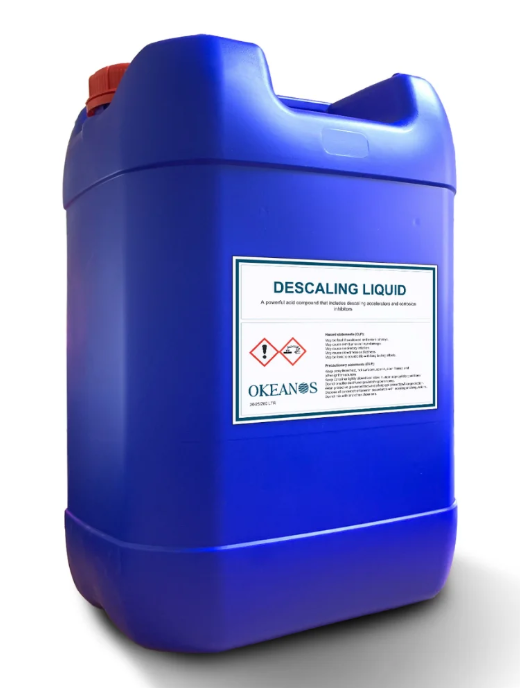
Descaling liquid is a chemical cleaning solution formulated primarily to dissolve and remove mineral deposits, limescale, calcium deposits, and hard-water scale.
Scale develops when dissolved minerals in water settle and accumulate on surfaces. This is particularly common in equipment that regularly handles or comes into contact with water, especially at elevated temperatures.
Depending on the application, scale can build up inside:
- Heat exchangers
- Boilers
- Cooling systems
- Water pipelines
- Tanks
- Pumps
- Valves
- Marine equipment
- Industrial processing equipment
- Water circulation systems
As the deposit becomes thicker, it can interfere with heat transfer, reduce flow capacity, increase energy consumption, and affect overall equipment efficiency.
A suitable descaling liquid works by chemically reacting with the mineral deposits and breaking them down so they can be removed from the equipment or surface.
What Is Scale Remover?
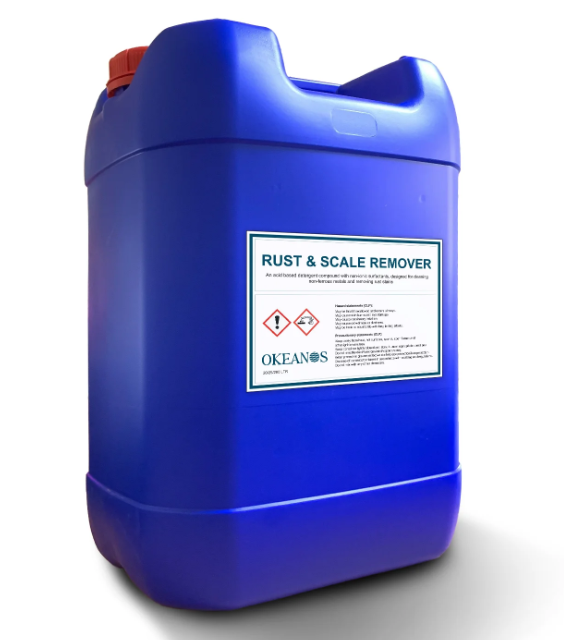
Scale remover is a broader term used for chemical products designed to remove accumulated scale deposits from surfaces and equipment.
The exact formulation and cleaning capability can vary considerably between products. Some scale removers are developed specifically for mineral deposits, while other formulations are designed to address more difficult deposits or combinations of scale and rust.
This distinction is important because not every scale deposit has the same composition.
For example, equipment may have a layer of calcium or mineral scale, while another surface may have both mineral deposits and corrosion-related rust. In the second situation, a product formulated for rust and scale may be more appropriate than a descaler intended mainly for mineral deposits.
Descaling Liquid vs. Rust and Scale Remover
The simplest way to understand the difference is to consider the type of deposit you are trying to remove.
A descaling liquid is generally selected when the main problem is mineral scale, limescale, or hard-water deposits.
A rust and scale remover is more appropriate when the surface has a combination of rust and scale deposits, provided the product is suitable for the particular material and application.
Descaling liquid is generally used for:
- Limescale
- Calcium deposits
- Mineral scale
- Hard-water deposits
- Water-related deposits
- Scale affecting heat-transfer surfaces
Rust and scale remover may be considered for:
- Rust deposits
- Mineral scale
- Combined rust and scale buildup
- Corrosion-related deposits
- Difficult deposits where both rust and scale are present
However, product selection should always be based on the actual deposit, surface material, concentration requirements, and manufacturer’s application instructions.
Why Does Scale Build Up?
Scale is mainly associated with minerals dissolved in water.
When water evaporates, heats up, or passes repeatedly through equipment, dissolved minerals can become concentrated and eventually precipitate onto surfaces. Over time, these deposits can form a hard layer.
The exact composition of scale depends on the water chemistry and operating conditions. Common scale-forming minerals can include calcium-based and other mineral deposits.
Several factors can contribute to scale formation, including:
Hard Water
Hard water contains higher concentrations of minerals such as calcium and magnesium. Repeated exposure can lead to significant mineral buildup.
High Temperature
Heating water can encourage certain dissolved minerals to precipitate and form deposits. This is why scale can be a significant issue in boilers, heat exchangers, and hot-water systems.
Continuous Water Circulation
Equipment that continuously circulates or processes water can experience gradual accumulation of deposits, particularly when water quality is not adequately controlled.
Poor Cleaning and Maintenance
Without regular inspection and cleaning, small deposits can gradually become thick and difficult to remove.
What Problems Can Scale Cause?
Scale may initially appear to be a minor cleaning issue, but heavy deposits can have a significant impact on industrial equipment.
One major concern is reduced heat-transfer efficiency.
For example, when a layer of scale forms on a heat-transfer surface, it acts as an insulating barrier. The equipment may require more energy to achieve the desired operating temperature.
Scale can also reduce the internal diameter of pipes and passages. This can restrict flow and increase resistance within the system.
Other potential problems include:
- Reduced equipment efficiency
- Restricted water or fluid flow
- Increased energy consumption
- Higher operating costs
- Increased maintenance requirements
- Reduced heat-transfer performance
- Equipment downtime
- Difficulty maintaining normal operating conditions
Removing deposits at the appropriate stage can therefore form an important part of preventive maintenance.
What Is the Difference Between Scale and Rust?
Scale and rust are not the same type of deposit.
Scale generally refers to mineral deposits that accumulate on surfaces, often as a result of hard water or repeated water exposure.
Rust, on the other hand, is associated with the corrosion of iron and steel. It forms when iron reacts with oxygen and moisture, producing iron oxide compounds.
The two can occur together, particularly in industrial and marine environments.
For example, a steel component exposed to water may develop corrosion while mineral deposits accumulate on the same surface. In such cases, simply choosing a product designed only for mineral scale may not address the entire deposit like ships.
This is where a suitable rust and scale remover in ships and other marine vessels may be considered, depending on the product’s formulation and the material being cleaned.
Can Descaling Liquid Remove Rust?
A descaling liquid should not automatically be assumed to be a rust remover.
Some acidic cleaning products may have an effect on certain corrosion deposits, but their primary purpose may be the removal of mineral scale. The ability to remove rust depends on the specific chemical formulation.
If rust is a major part of the deposit, it is better to select a product specifically designed for rust removal or combined rust-and-scale cleaning.
Always check the product’s technical information before applying a chemical to equipment or surfaces.
Can Scale Remover Remove Limescale?
Yes, depending on the formulation.
Many scale-removing products are designed to dissolve mineral deposits, including limescale. However, not all products have the same strength, chemical composition, or recommended applications.
Before selecting a scale remover, identify:
- The type of scale present
- The surface or equipment material
- The thickness of the deposit
- The operating environment
- The required cleaning method
- The manufacturer’s recommended application
Choosing a chemical based only on the word “scale remover” may not be sufficient for demanding industrial applications.
How to Choose the Right Descaling Chemical
Selecting the right cleaning chemical begins with identifying the deposit.
1. Identify the Deposit
Determine whether the buildup is primarily mineral scale, limescale, rust, or a combination of deposits.
If the deposit is mainly mineral-based, a suitable descaling liquid may be the appropriate choice.
If both rust and scale are present, consider a formulation designed specifically for combined deposits.
2. Consider the Surface Material
Different metals and materials can react differently to cleaning chemicals.
Before using a chemical, verify that it is compatible with the surface being treated. This is particularly important when cleaning sensitive metals, coatings, seals, or components.
3. Consider the Equipment
The cleaning requirements of a heat exchanger may differ from those of a tank, pipeline, pump, or marine component.
The application method, chemical concentration, contact time, and rinsing requirements should be determined according to the equipment and product instructions.
4. Follow the Manufacturer’s Instructions
Do not assume that using a higher concentration will always produce better results.
The recommended dilution, application procedure, contact time, temperature, and safety precautions should be followed according to the product’s technical documentation.
Descaling Liquid for Industrial Applications
Industrial descaling is often carried out as part of planned maintenance.
Heat exchangers, boilers, pipelines, tanks, and water-handling systems can gradually accumulate mineral deposits during normal operation. If deposits are allowed to remain for long periods, they can become increasingly difficult to remove.
Using an appropriate descaling liquid as part of a maintenance program can help control mineral buildup and maintain equipment cleanliness.
The frequency of descaling depends on factors such as:
- Water quality
- Equipment operating temperature
- Type of equipment
- Operating hours
- Deposit formation rate
- Previous maintenance history
Rather than relying on a fixed cleaning interval for every application, businesses should monitor equipment condition and determine an appropriate maintenance schedule.
Descaling in Marine and Coastal Environments
Marine and coastal equipment can face particularly demanding operating conditions. Equipment may be exposed to seawater, humidity, mineral deposits, corrosion, and contaminants.
Scale and corrosion deposits can accumulate on various components and surfaces, potentially increasing maintenance requirements.
For marine applications, chemical compatibility becomes particularly important. The cleaning product should be selected based on the equipment material, type of deposit, and intended application.
Where both corrosion and scale are present, a suitable rust and scale removal product may provide a more appropriate cleaning approach than a product designed only for mineral deposits.
How Does Descaling Help Equipment Maintenance?
Regular removal of mineral deposits can support equipment maintenance by preventing excessive buildup.
For heat-transfer equipment, controlling scale can help maintain effective heat transfer. For pipelines and fluid passages, removing deposits can help prevent excessive restriction.
Descaling should therefore be viewed as part of a broader maintenance program rather than simply an emergency cleaning procedure.
Regular inspection can help identify deposits before they become severe.
Important Precautions When Using Descaling Chemicals
Descaling chemicals can contain active chemical ingredients that require careful handling.
Before using any descaling or scale-removal product:
- Read the product label and technical documentation.
- Follow the recommended dilution and application instructions.
- Confirm material compatibility.
- Use appropriate personal protective equipment.
- Ensure adequate ventilation where required.
- Avoid mixing chemicals unless specifically permitted.
- Follow the recommended rinsing procedure.
- Dispose of used chemicals according to applicable requirements.
For large industrial systems, professional guidance may be appropriate before starting a chemical cleaning process.
Which Product Should You Choose?
The choice ultimately depends on the deposit.
If your main concern is limescale, mineral deposits, or hard-water scale, a suitable descaling liquid is generally the more relevant type of product.
If the surface has both rust and scale, a product specifically formulated for rust and scale removal may be more suitable.
The key is not to choose a product based only on its name. Consider the deposit composition, surface material, equipment type, and cleaning requirements.
Descaling and Scale Removal Solutions from OKEANOS
Okeanos provides chemical solutions for industrial cleaning and maintenance applications.
If you are dealing primarily with mineral deposits and limescale, explore OKEANOS Descaling Liquid to learn more about the product and its intended applications.
For applications involving both rust and scale deposits, visit the OKEANOS Rust and Scale Remover page for more information.
If you are unsure which product is suitable for your application, contact the Okeanos team and provide details about the type of deposit, equipment, surface material, and cleaning requirement. The right product selection can help you achieve effective cleaning while protecting your equipment and supporting reliable maintenance.
Get Effective and Reliable Marine Chemical Solutions in UAE
Descaling liquid and scale remover are closely related terms, but they should not always be treated as identical products. A descaling liquid is generally focused on mineral scale and limescale, while scale-removing products can have broader applications depending on their formulation. When rust and mineral deposits occur together, a dedicated rust and scale remover may be a better option.
Identifying the deposit before choosing a chemical is the most important step. With the right product, application method, and maintenance approach, businesses can manage scale buildup more effectively and help keep industrial equipment operating efficiently. Explore our industrial cleaning chemicals for each application.
Need help selecting the right cleaning chemical? Contact OKEANOS today to discuss your descaling, scale removal, or rust removal requirements.